
Crab Island Today
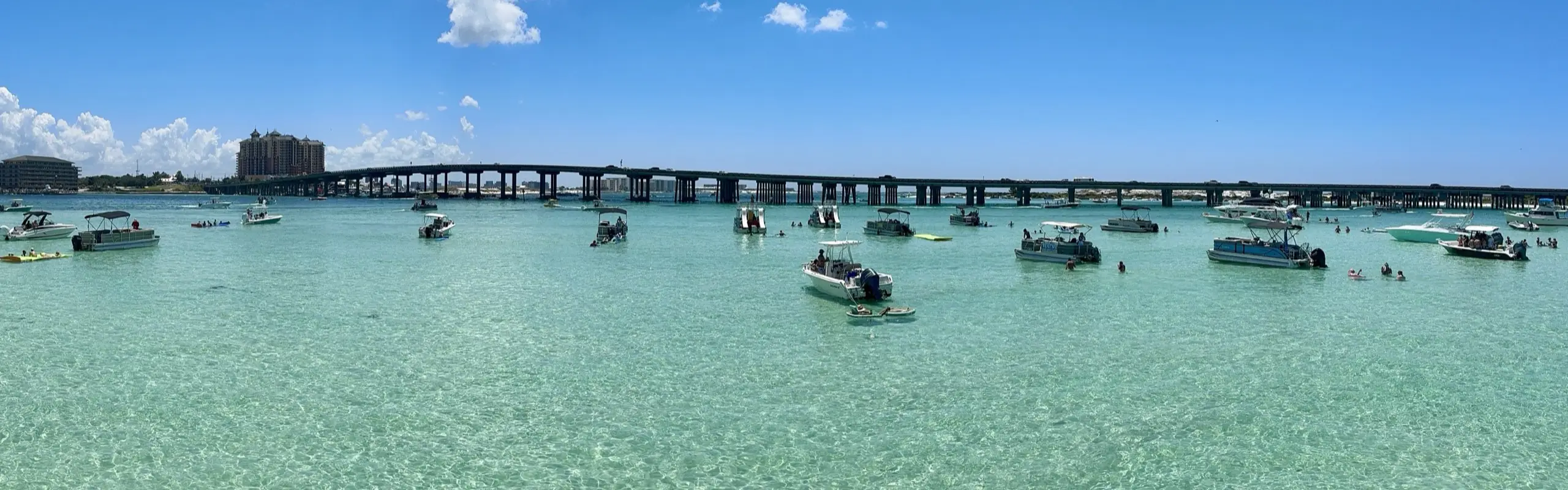
Crab Island, Destin
Currents, kids, jellyfish, boat traffic — what to actually worry about, and how to plan around it.
Crab Island isn't an island, isn't a beach, and isn't a pool. It's a submerged sandbar in Destin Harbor with thousands of boats anchored on top of it on a peak summer day. Most of the time, it's the best swim in the panhandle. The rest of the time, it's open water with tidal currents, a drop-off you can't see, and boat traffic that doesn't slow down for a kid on a float.
Here's what to actually worry about and how to plan around it.
The sandbar is shallow in the middle — 1 to 4 feet in most spots — and stays shallow for several hundred feet in every direction. Then it isn't. The east and south edges drop sharply into 10+ feet of water, and the bottom there is sloping sand, not a ledge.
That slope matters most on an outgoing tide. When the tide turns and the water starts pulling back toward East Pass, the current accelerates along the edges. A swimmer who walks past the shallow zone into chest-deep water on the east or south side can lose their footing in soft sand and get pulled into deeper water faster than they expect.
The rule: don't go deeper than your hips on the east or south sides. Anchor in the middle, north, or west of the sandbar. The Coast Guard and FWC actively advise against swimming the channel for the same reason — tidal currents under the Marler Bridge make it a worse swim than it looks.
Where you anchor matters. Your kids will swim where you anchor.
Jellyfish at Crab Island are seasonal. The species you're most likely to encounter:
Peak season for all three is late July through early September, with the worst weeks usually right after a tropical system pushes them inshore. We track jellyfish risk on the conditions dashboard so you can check before you commit to a long day.
For stings: rinse with saltwater or vinegar, not fresh water. Fresh water makes unfired stinger cells fire. Scrape off any tentacles with the edge of a credit card, not your hand. Hot water (as hot as you can tolerate) helps with sea nettle pain. For sea-lice rash, rinse the swimsuit in vinegar and don't wear it back into the water without washing it.
The water under and around the Marler Bridge is a no-wake area. Florida calls it either "Idle Speed - No Wake" (the minimum speed needed to maintain steerage) or "Slow Speed, Minimum Wake" (off plane, fully settled). FWC, the Okaloosa County Sheriff's marine unit, and municipal police all enforce it. They do enforce it.
Once you're on the sandbar itself, you're in a high-density anchorage. Etiquette that nobody prints on a brochure:
Florida BUI law applies on the water — same threshold and penalties as a DUI. Full rules: Know Before You Go.
Florida law requires any child under age 6 to wear a USCG-approved Type I, II, or III life jacket on a vessel under 26 feet while underway. That's the legal minimum. The practical answer is broader.
For non-swimmers and weak swimmers regardless of age, keep a vest on at the sandbar — not because the water is over their head where you anchor, but because the bottom isn't flat. A kid steps into a soft spot, loses their footing for two seconds, and panics. A puddle-jumper or Type III vest buys you those two seconds.
Keep kids in the shallow middle of the bar, away from the east and south edges. Watch the boat lanes. The water you're standing in is the same water boats are anchoring in.
